At a glance
-
Brand: Haigh & Hastings
-
Product: M2 Greenbriar dive watch
-
Starting point: Existing beach photography of a suited model from two years earlier
-
New deliverable: 15-second vertical product film
-
New environments: A generated liminal office, an extended beach sequence and underwater frames
-
Approach: Creative direction, Photoshop compositing, AI-assisted motion, DaVinci Resolve finishing and original sound design
-
Project type: Self-initiated Byline concept using archived client photography
The opportunity
Strong brand photography usually stops working long before the idea inside it does.
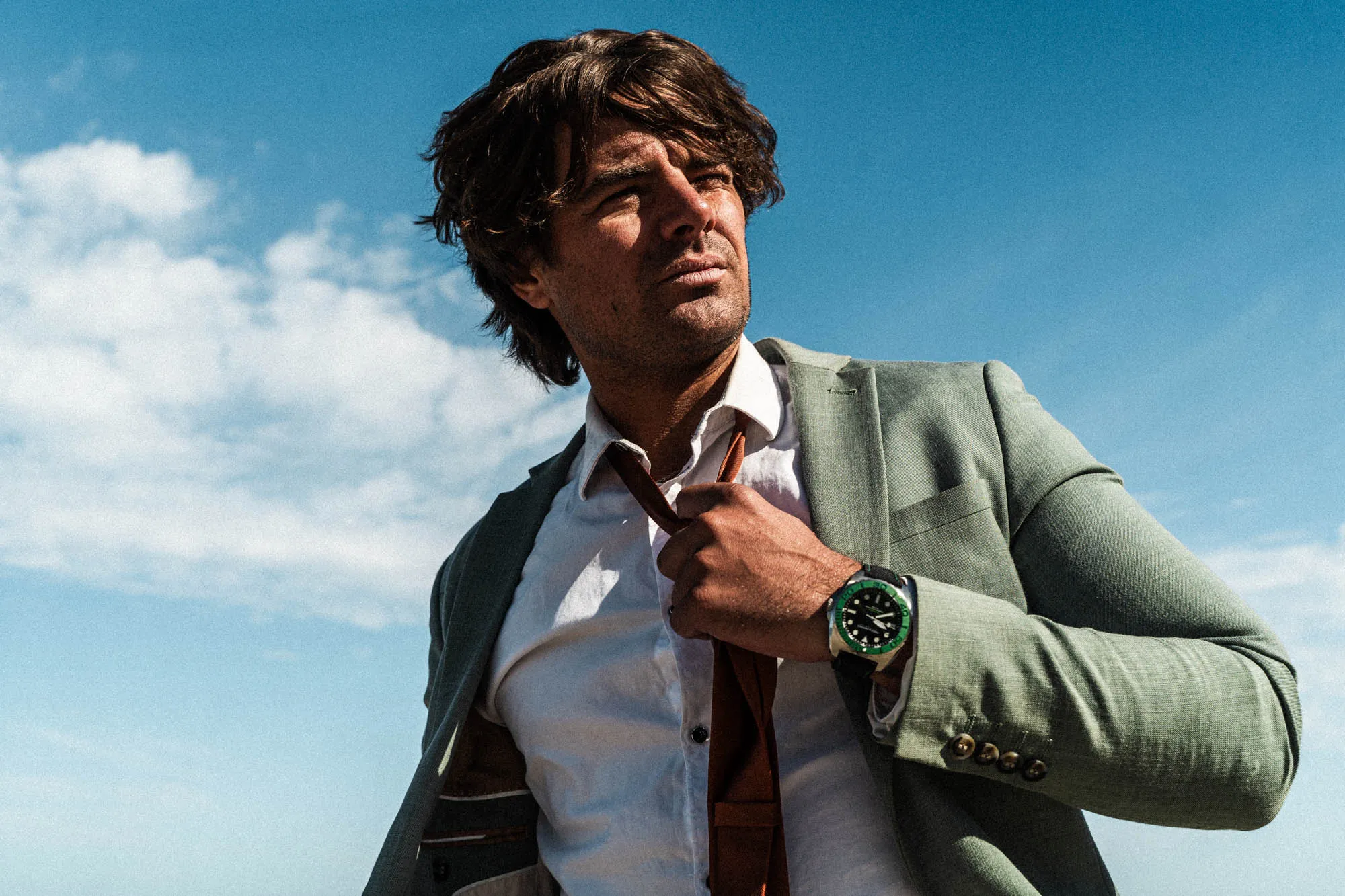
The original Haigh & Hastings shoot placed a suited model at the beach with the M2 Greenbriar clearly visible. It already had the product, talent and styling; what it did not have was a narrative built for vertical video.
The unusual styling suggested the missing first act. The model looked as though he had walked out of an office and straight towards the water. Rather than inventing a new beach setting, the campaign built an office backwards from the existing photographs.
That became the campaign proposition:
You don’t wear a dive watch to sit at a desk.
What the campaign became
The 15-second film moves through three simple states:
-
Office: Newly created macro details of the model and watch reveal an endless fluorescent workplace inspired by the Backrooms. It feels repetitive and directionless rather than physically claustrophobic.
-
Release: A match cut holds the composition while the invented office gives way to the beach world already established by the original shoot. The model removes his tie and the film opens into natural light and movement.
-
Purpose: The model enters the ocean and the film resolves on underwater details of the Greenbriar, finally placing the watch in the environment it was designed for.
The idea works because the product is part of the story. The office does not merely look unusual, and the beach is not just a lifestyle backdrop. Each setting changes what the watch means.
What had to be controlled
Turning stills into motion only works if the output still feels like the same campaign.
The product had to remain the product
The Greenbriar’s bezel, dial typography, crown, strap and case proportions were easy for a video model to reinterpret. Real product details were composited back into reference frames and corrected during finishing. A believable dive watch was not enough. It had to remain this dive watch.
The references had to carry the direction
Colour, wardrobe, anatomy, skies, lighting direction and perspective were established in Photoshop before animation. A product sheet locked the Greenbriar from multiple angles; a character sheet locked the model’s face, build and wardrobe. Better reference frames reduced the number of decisions left to the generator.
The prompting structure drew from Higgsfield’s published 3-Step Workflow To Make Ultra-Realistic AI Ads: build recurring assets first, then specify camera, lighting, movement, physics and continuity at shot level. The useful lesson was not to make prompts longer for their own sake. It was to remove ambiguity before generation.
The footage had to behave like a camera
Depth maps, selective lens blur, tracked replacements and rebuilt motion blur were used to remove the brittle sharpness and inconsistent focus common in generated video.
The edit still needed rhythm
The shots were designed around controlled reveals. Each new frame introduced information before the previous idea ran out of attention. Sound was built manually so the office remained restrained and the beach transition felt like a genuine release.
Where AI made commercial sense
The underwater product frames are the clearest example.
Capturing it properly would require reliable underwater camera protection, controlled access, safety planning and enough light for the footage to survive the grade. My Sony A7 IV can shoot beyond ISO 3200, but that is around my practical noise ceiling for this kind of work. An FX3 offers a stronger high-sensitivity workflow around ISO 12,800, although it also adds rental, housing and production cost.
For a brief insert, that setup can be out of proportion to the value of the shot. AI made the image possible without turning a two-second detail into a specialist production day.
That does not mean the entire campaign was easier to generate than shoot. It was not. If the original production had been planned for motion, controlled lighting and product fidelity would have produced a smoother and more predictable result.
Generate it, shoot it or combine both?
| Situation | Better approach | Why |
|---|---|---|
| Specialist, unsafe or inaccessible shot | AI extension | Avoids equipment, access or safety costs that outweigh a brief shot’s value. |
| Short contextual insert | AI extension | Can add clarity or pacing without another location or shoot day. |
| Exact hero product detail | Live production | Geometry, typography, reflections and materials remain dependable. |
| Performance-led scene | Live production | Direction, expression and continuity are easier to control. |
| Strong existing assets with one missing visual beat | Hybrid | Keeps the real campaign intact while filling a specific gap. |
| Entire campaign available to plan from scratch | Usually live or hybrid | Creates a more predictable route to consistent, finishable footage. |
What brands should take from this
AI is most useful when it solves a production constraint, not when it becomes the concept.
Before commissioning another shoot, review what you already have:
-
Are there strong photos that never became motion?
-
Is there an unused contradiction, claim or story inside them?
-
Which new shots would make that idea clear?
-
Which of those shots genuinely require another production day?
-
Which could be created as controlled extensions without risking the product or brand?
The answer may still be a new shoot. It may also be one new shoot combined with a small number of generated shots. The useful decision is not whether a campaign should use AI. It is which images deserve real production, and which do not.
The approach Byline will keep using
We would not rush to generate another whole campaign in the same way. Too much time was spent repairing material that could not be fully controlled.
We will keep using AI for impossible angles, specialist environments, short inserts, archive extensions and pacing fixes. The hero product, performance and lighting will still be captured for real whenever production can reasonably control them.
Use AI for the shots production cannot justify. Shoot the rest properly.
If strong brand photography is sitting in your archive, there may already be another campaign inside it. Talk to Byline Creative.